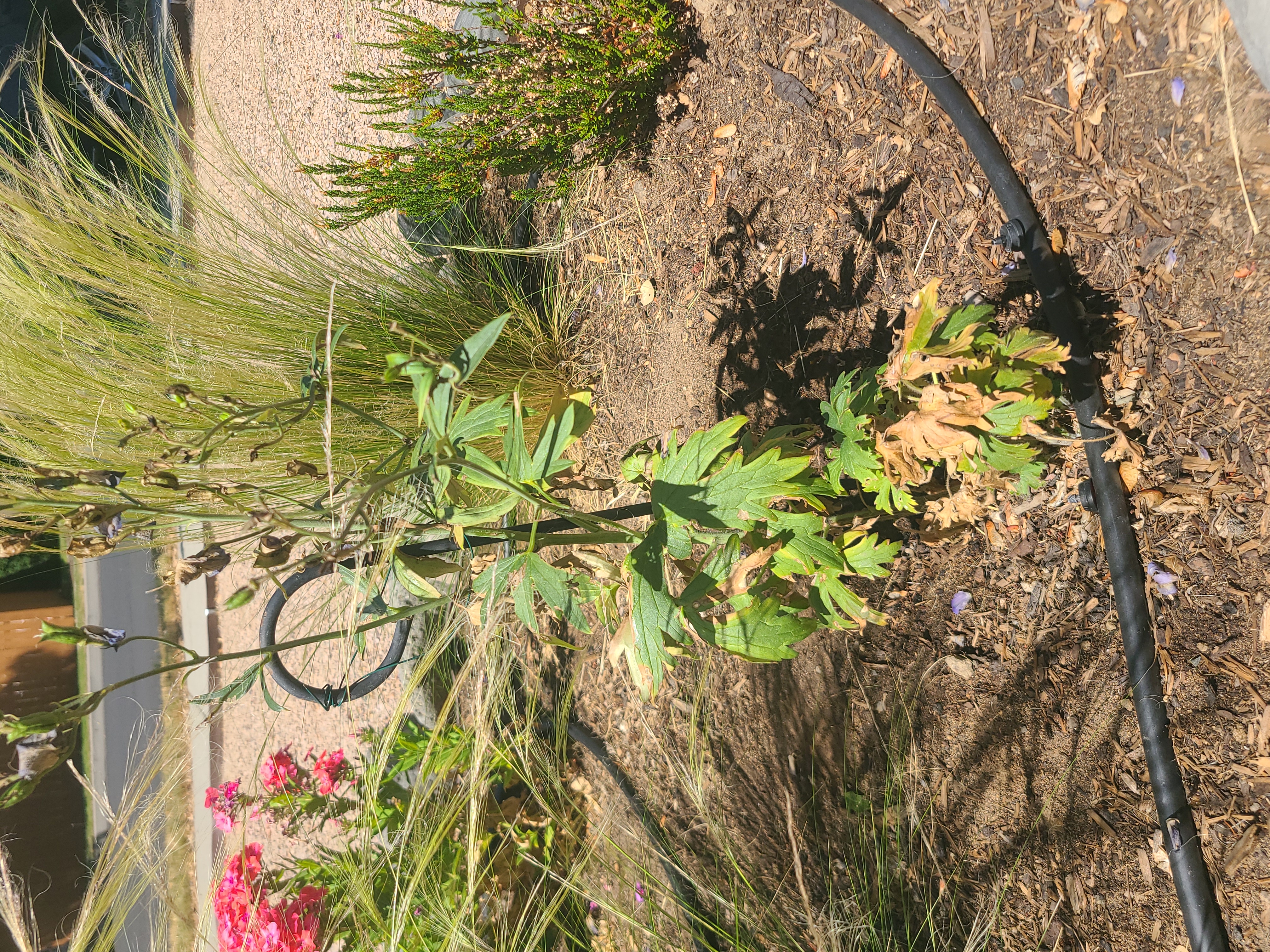
Yes. These new pictures make me substantially more confident that it really is a delphinium, rather than just something vaguely delphinium-ish.
The clincher is in your first and third photos: those odd little green-to-brown structures are delphinium seed pods. A delphinium flower typically develops three follicles joined at the base, which mature from green to brown and eventually split to release the seeds. That three-pronged, horned little capsule is quite distinctive.
The foliage supports it too. Delphiniums have divided, palmately lobed leaves, with the leaves higher up the stem often becoming much narrower and simpler than the big basal leaves. That's why the foliage can look almost like two different plants when you're looking at different heights on the stalk.
And now I would change today's cleanup slightly
This flower stalk is finished enough that I would cut the entire spent flowering stem off now. I wouldn't bother clipping each individual brown pod. Follow the tall stalk downward until you reach the healthy leafy portion near the base and cut the old flowering stalk there.
Those green pods in your third picture are still developing seeds. So there are two options:
If your daughter wants seeds: leave a few pods until they turn brown and begin to open, collect them, then remove the stalk.
If she doesn't care about seeds: cut the stalk now. The plant doesn't need to spend additional energy ripening them.
I would leave the healthy green lower foliage alone, though. Some of those lower leaves are yellowing and browning, and you can remove the completely dead ones. But the green leaves are still feeding the crown underground for next year's plant.
Then, once the plant has actually gone dormant after frost, Central Oregon guidance is to cut dormant perennial stems back to roughly 6–8 inches, which also leaves enough structure to trap insulating snow. Waiting until spring to remove the remaining stems is also perfectly legitimate.
So this particular one gets a two-stage haircut:
Now:
✂️ tall spent flower/seed stalks off
🍃 dead yellow/brown leaves off
🌿 healthy green basal leaves stay
After frost/dormancy:
✂️ remaining dead top growth to about 6–8 inches
And your pictures also explain why it looks rather bedraggled compared with those ridiculous show-off phlox plants behind it. The delphinium has already completed its major flowering cycle and is making seed, while the phlox is still partying. Nothing in these new pictures makes me think the delphinium is simply dying from neglect.
One small practical note because delphinium is unusual in this respect: all parts contain toxic alkaloids if eaten, so I'd put the cuttings where pets can't decide that today's garden debris is a salad bar.
_________<
The first and fourth photos look very much like a delphinium, probably one of the perennial garden hybrids. The tall staked flower stalk, deeply divided leaves, and especially those little developing/dried seed capsules along the old flower spike are characteristic of delphinium.
For that one, it is clearly reaching the scruffy end-of-summer chapter now. I would cut off the spent flower stalks now, especially the brown seed-bearing portions, but leave the healthy lower green foliage for the moment. Once frost has killed the foliage and it has turned brown, the remaining stems can be cut down to several inches above the ground and the dead material cleaned away. Delphiniums are herbaceous perennials, so the visible plant essentially disappears for winter and comes back from the crown.
The browning lower leaves in your close-up don't alarm me much at this point in August. The plant has already put a tremendous amount of energy into flowering and seed production, and those old lower leaves are starting to retire. I would remove leaves that are completely brown, but don't strip off all that remaining green growth yet.
The big rounded shrub in photos two and three is Japanese spirea, Spiraea japonica, or one of its closely related hybrids/cultivars. That identification I'm considerably more confident about. The small serrated leaves, dense rounded habit and flat clusters of pale pink flowers fit it beautifully. Oregon State describes S. japonica cultivars with exactly that mounded form and pink flower clusters.
And I would give the spirea an almost opposite fall treatment:
You can snip off all those brown spent flower clusters now if your daughter wants it tidied up.
Take out anything obviously dead, damaged or broken.
But don't give the whole shrub a serious haircut this fall.
Let it naturally go dormant and drop its leaves.
If she wants to reduce its size, reshape it, or rejuvenate it, late winter/early spring before new growth starts is the better time for this type of late-blooming spirea. These bloom on new growth, so spring pruning works very well.
If it ever gets old and woody, spirea is extremely forgiving. An overgrown plant can even be rejuvenated quite dramatically in early spring.
For the same Central Oregon garden, I would also make sure both get a good deep watering before the ground freezes if autumn is dry, rather than keeping them on frequent shallow irrigation. Fall pruning that stimulates new growth is generally undesirable going into cold weather.
So the shorthand for today's cleanup is wonderfully simple: delphinium: remove the ugly spent stalks, wait on the green base. Spirea: deadhead it if desired, but save the real pruning for spring.
And the spirea, incidentally, looks terrific. That thing has turned itself into a very respectable green meatball. 🌿