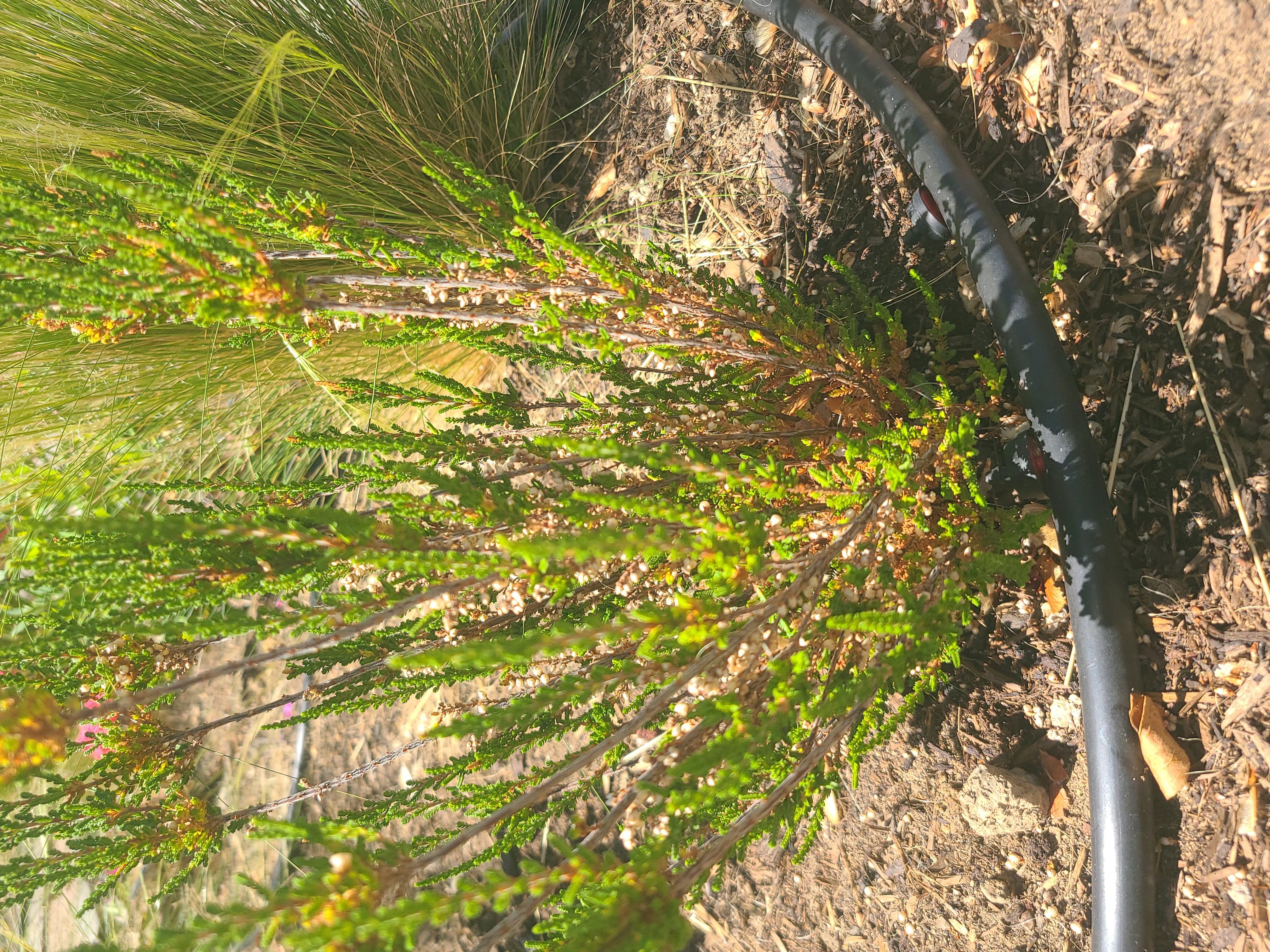
Yes, this is the little evergreen shrub that was showing up beside the grasses in the earlier pictures. With these close-ups, I’m quite confident it is common heather, Calluna vulgaris, also called Scotch heather. The tiny overlapping scale-like leaves and those persistent little dried flower structures along the stems are characteristic of Calluna.
For this one, do not cut it down for winter. It is an evergreen woody shrub, not a perennial that disappears underground. The green foliage stays and continues to be the plant.
What I would do this fall is give it a very light haircut after flowering is finished. The pale tan/white structures you're seeing are mostly old flower remnants. You can shear those flowering tips back just enough to remove the spent flowers and keep the plant compact. The important boundary is: stay in the leafy green portion of the stems. Do not cut back into the bare gray woody stems. Calluna is notoriously poor at resprouting from old wood.
And I think that distinction matters with this particular plant, because your close-up shows quite a few older gray, leafless stems mixed among vigorous green ones. I would inspect those individually. If a gray stem is genuinely dead, brittle all the way down and has no green growth anywhere on it, you can remove that dead stem at its origin. But I would not try to rejuvenate the whole shrub by chopping all those woody stems low. That's exactly the sort of pruning heather often refuses to forgive.
The winter-care recipe is otherwise very low drama:
Lightly trim off the spent flowering portions after bloom.
Leave all healthy green foliage.
Remove completely dead/broken stems individually.
Don't fertilize it heavily in fall. Heather is adapted to relatively lean soil.
Keep the soil from becoming bone-dry during a prolonged dry fall, but don't keep it wet. Heather wants moist but extremely well-drained soil.
Don't bury the crown under a heavy wet mulch. In-ground Calluna generally needs no special winter protection when it is growing within its hardiness range.
There is something interesting in the photo, too. This one is getting a bit leggy. You can see vigorous green growth toward the ends and some naked woody stems farther down. That doesn't mean anything is terribly wrong, but it suggests that annual light trimming probably wasn't done consistently in previous years. Heather stays much denser if its flowering growth is lightly trimmed every year rather than being allowed to build successive layers of woody stems.
So this is another plant where I'd resist the temptation to conduct a fall massacre with the shears. 😄 Take off the spent flower tips, clean out truly dead wood, and otherwise leave the little shrub alone.
And compared with the delphinium right next door, these two could hardly have more different instructions: delphinium eventually gets cut almost to the ground; heather absolutely does not.