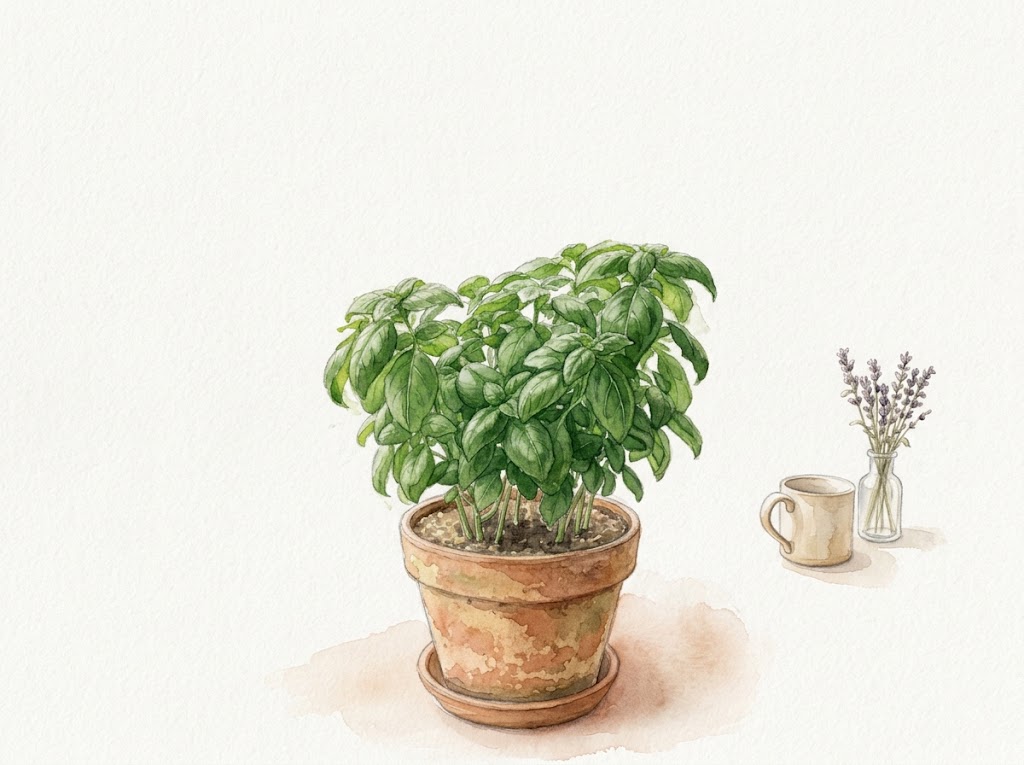
Basil has a reputation for being easy to grow, and in the right conditions, it is. But "easy" doesn't mean "hands-off." These are some of the most important step to maintaining its tender, aromatic leaves.
Left entirely to its own devices, basil tends to get leggy, loosing the leaves that make it worth growing in the first place.The plant that ends up bushy, productive, and flavorful all summer is usually the result of a handful of simple habits: giving it enough light and warmth, watering consistently without waterlogging the roots, feeding it lightly, and — perhaps most importantly — pruning it correctly and often.
Of all these, pruning tends to trip people up the most. It's not intuitive to cut back a plant that's growing well, and it's easy to prune in a way that stunts growth rather than encouraging it. Get the other basics right, though, and pruning becomes the one habit that determines whether your basil stays a compact, leafy workhorse or bolts into a tall, sparse, flower-covered stalk by midsummer. Below, we'll cover what basil needs to thrive, and then walk through exactly how — and why — to prune it.
Container Depth Matters More Than You Might Think
Two basil plants, started under nearly identical conditions, can end up looking like entirely different species after a few months — and the difference often comes down to one overlooked variable: the shape of the container.
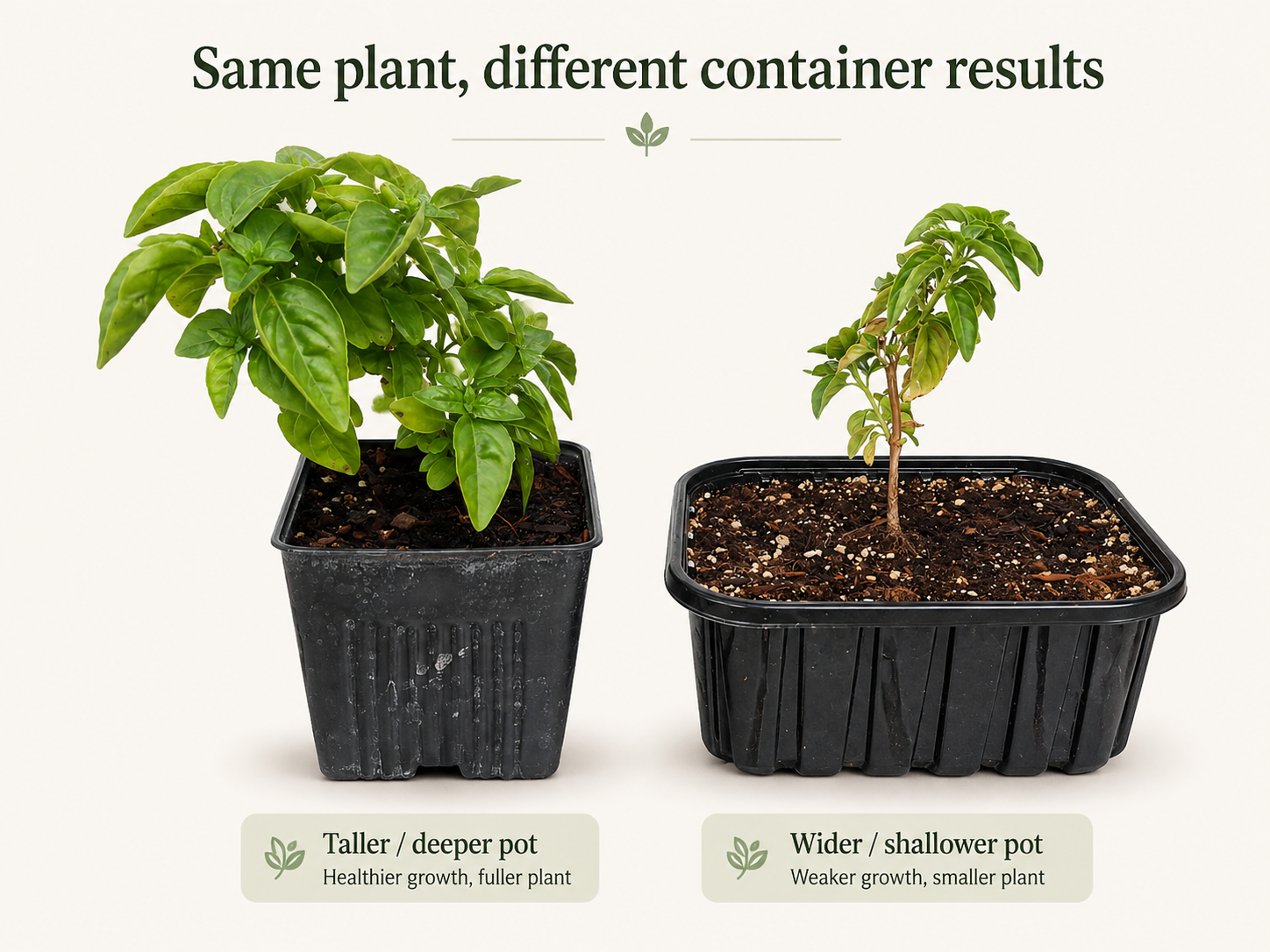
Both plants pictured here were grown from the same mother seeds, then raised side by side for their entire lives — same location, same sunlight exposure, same fertilizer, and the same watering amount and schedule. In other words, nearly every variable that typically explains a difference in plant health was held constant. The one thing that wasn't controlled was the container itself: one plant grew in a taller, narrower pot, and the other in a wider, shallower one. That makes the difference between them less of an ambiguous case and closer to a clean, if accidental, experiment — with container geometry standing out as the most likely explanation for two genetically similar plants ending up in such different condition.
Take a plant grown in a tall, narrow pot next to one grown in a wide, shallow container. The tall-pot plant tends to be dense, deep green, and heavily branched — every signal of a plant putting energy into new growth. The shallow-pot plant, even with the same watering and light, often ends up sparse and woody, with smaller, curled leaves and some yellowing. It looks less like a struggling plant and more like one stuck in maintenance mode — surviving, but not thriving.
The instinct is to blame fertilizer or sunlight. But container geometry deserves to be high on the suspect list, because a shallow, wide pot changes several things at once, even when it holds just as much soil overall:
- Root depth. Basil can develop a fairly substantial root system if given the room. A tall pot lets roots grow downward; a shallow one forces them to spread sideways instead, which limits how much the plant below ground — and above it — can develop.
- Water behavior. A broad, shallow mass of soil dries out and rewets very differently than a deep column of soil, simply because the surface-area-to-volume ratio is different. Watering both containers on the same schedule doesn't mean the roots are experiencing the same moisture conditions.
- Temperature swings. A wide container exposes more surface area to sun and warm air, so the root zone can heat up and cool down faster — and more dramatically — than in a deeper, more insulated pot.
- Oxygen and moisture distribution. Water and air don't move through a shallow, broad root zone the same way they do through a taller one, which affects how evenly the roots can take up what they need.
It's worth noting: bigger isn't automatically better. A container can hold more total soil and still be the wrong shape for the plant. And the visible symptoms of a struggling root system — yellowing, curling, stunted new growth — can easily be mistaken for a nutrient deficiency, even when nutrients are plentiful in the soil. If roots can't take up what's there, the plant shows the same stress signals as if the nutrients weren't available at all.
One caveat worth keeping in mind: if two basil plants started as cuttings from different parts of the same original plant, they weren't necessarily identical on day one — one cutting may have rooted more vigorously from the start. But when a gap this consistent persists for months, the container itself becomes the more compelling explanation.
The takeaway: when potting basil, prioritize depth over surface area. A narrower, deeper container will generally outperform a wider, shallower one — even if the shallow pot technically holds more soil.
How to Prune Budding Flowers Off a Basil Plant (and Why It Matters)
Why Trimming the Flowers Matters
Basil is an annual whose whole biological goal is to flower and set seed once conditions — warmth, day length, plant maturity — trigger it. The moment a stem commits to flowering, the plant shifts its energy away from leaf production and into the flower spike, building bracts, blooms, and eventually seeds instead of the tender foliage you actually want to eat.
There's also a flavor and texture cost. Once a basil plant starts flowering — a process usually called "bolting" — the leaves, especially near the flowering stems, tend to get smaller, tougher, and more bitter. The plant is essentially reallocating resources toward reproduction, and leaf quality is the first thing to suffer.
Removing the flower spikes (often called "pinching," even when done with scissors) tricks the plant into staying in vegetative mode. Without a flower to finish, the axillary buds at the node below your cut take over as new growth points, and the plant keeps producing fresh leafy branches instead of seed.
What Happens If You Don't Trim
If you leave the flower spikes alone, a few things happen in sequence:
- The plant gets leggy and sparse. Instead of branching out from lower nodes, energy stays concentrated at the flowering tips, so the plant grows tall and thin rather than full and bushy.
- Leaf production slows and quality drops. New leaves get smaller, and older ones often turn slightly bitter or develop a coarser texture as the plant's chemistry shifts toward reproduction.
- The flowers open and set seed. Basil flowers are small, usually white or purple, arranged in whorls up a spike. Once pollinated, they form seeds.
- The plant's lifecycle starts winding down. Since basil is treated as an annual in most gardens, once it goes fully to seed, it tends to decline — the whole plant, not just the flowering stems, gets woody and less productive, and it often dies back not long after seed set.
Letting basil flower isn't catastrophic — some gardeners let a portion of the plant bolt for the bees, or to save seed for next year — but if the goal is a steady supply of tender, flavorful leaves, regular flower pruning is what keeps the plant in that productive, leafy state rather than racing toward the end of its lifecycle.
How to Prune Flowers Off a Basil Plant
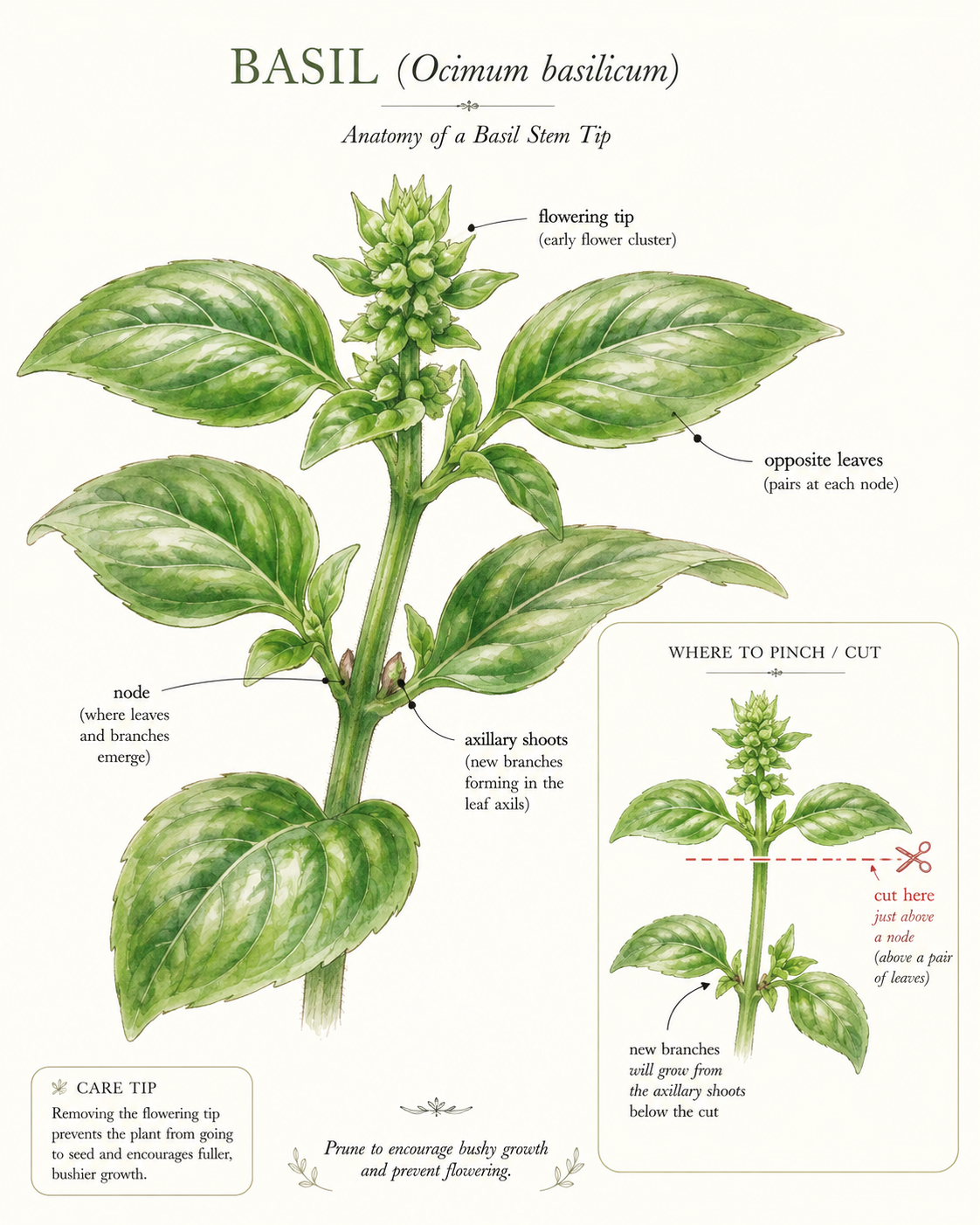
Once basil starts to bolt, tight little clusters form at the tips of the stems — these are flower spikes in the making. The trick isn't just to pluck off the buds; it's to remove the whole flowering tip and force the stem to branch.
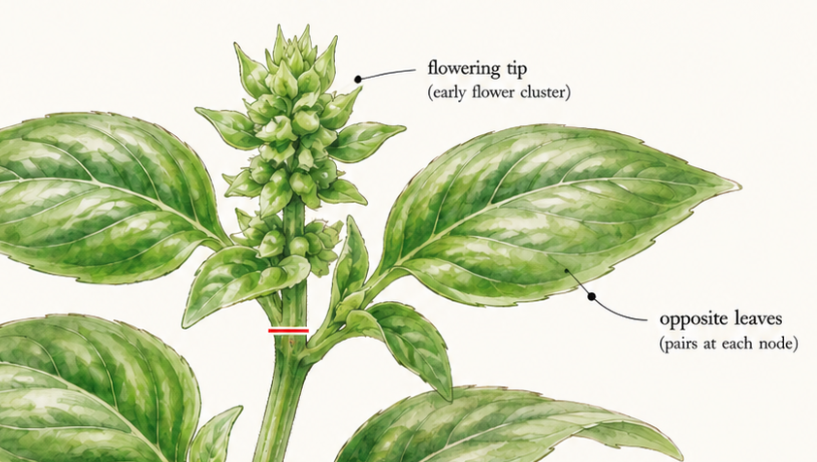
Find the node. Follow the flowering stem down until you reach a pair of full-sized, healthy leaves growing opposite each other. Right where those leaves meet the stem, you'll usually spot tiny new shoots tucked into the leaf axils — this junction point is called a node.
Make the cut. Snip the main stem about ¼ inch above that node — not through it, and not way above it. Cutting too close to or through the node can damage the buds and stunt the new growth; cutting too high leaves unnecessary flowering stem behind.

What happens next. Once you remove the flowering tip, the two small shoots at that node are released from the tip's dominance and take over as new leaders. One flowering stem becomes two leafy stems — this is the basic mechanism behind why pruning makes basil bushier.
A Few Practical Notes
- Don't be too gentle. On stems that are clearly committed to flowering, it's fine to cut down one or even two nodes below the flower cluster rather than just nipping the very top.
- Don't overdo it in one session. Removing roughly the top 25–35% of flowering growth per pruning is a reasonable target. If nearly every tip is flowering, work around the whole plant and cut each stem back to a healthy leafy node rather than shearing everything to one uniform height.
- Ignore damaged leaves when choosing your cuts. Older leaves may show bronze or brown patches, but that shouldn't determine where you prune — base your cuts on healthy nodes and vigorous new side shoots instead.
A Note on Plant Anatomy
It helps to know what you're actually looking at near the flower cluster. The small, pointed leaves right up against the flower spike are bracts — modified, reduced leaves associated with the flowers themselves, not normal foliage. Separately, any narrow young leaves lower on the stem are simply immature side shoots — ordinary leaves that will fill out into full branches if left alone. Basil's regular foliage grows in opposite pairs along the stem, while its flowers form in small clustered whorls with these bracts attached.
The sequence to keep in mind: a normal leaf pair produces axillary buds, which grow into new branches. In the flowering region, by contrast, the stem produces small bracts instead of leaves, followed by the flowers. This is why you should never cut in the middle of that bract-and-flower zone — trace the stem down to a real leaf pair first, then cut just above it.

For the basil harvest tonight, the main thing is to keep the leaves as dry as possible before storing or freezing. If you’re processing a lot at once, you can portion it depending on future use: some chopped for sauces/soups, some maybe frozen in olive oil, and some kept fresher for tomorrow if the leaves are still in good shape